Fossil sepia drawings of an ichthyosaur skull from the collection of Elizabeth Philpot (1779–1857): a new addition and the present location of the specimen by Tom Sharpe, Hugh Torrens and Sarah King
From GeoHistories, no 81, April 2026, 17-19.
Fossil sepia drawings of an ichthyosaur skull from the collection of Elizabeth Philpot (1779–1857): a new addition and the present location of the specimen
Tom Sharpe, Hugh Torrens and Sarah King
Text version:
A drawing of an ichthyosaur skull by Elizabeth Philpot (1779–1857) and sent to Mary Buckland (1797–1857) in Oxford on 9 December 1833 is a much-celebrated example of the use of fossil sepia as a drawing medium. Her sketch (Fig. 1) of a specimen in her and her sisters’ collection shows a skull with a well-preserved sclerotic ring and a rostrum displaying many small teeth, with the bones of the skull and neck still in their limestone matrix. Beneath, a caption reads ‘A Jaw of the Ichthyosaurus communis / from the lias, Lyme Regis. / Drawn with colour prepared from / the fossil Sepia contemporary with / the Ichthyosaurus’ and in the lower left corner ‘Half the natural size’ (Oxford University Museum of Natural History OUMNH WB/A/3/022). Philpot seems to have made several copies; a second copy is in the Buckland archive in Oxford (OUMNH WB/A/3/022) Fig. 2) and a third (Fig. 3) was probably that given by Henry De la Beche (1796–1855) to the Geological Society on 25 March 1834 (LDGSL/642).
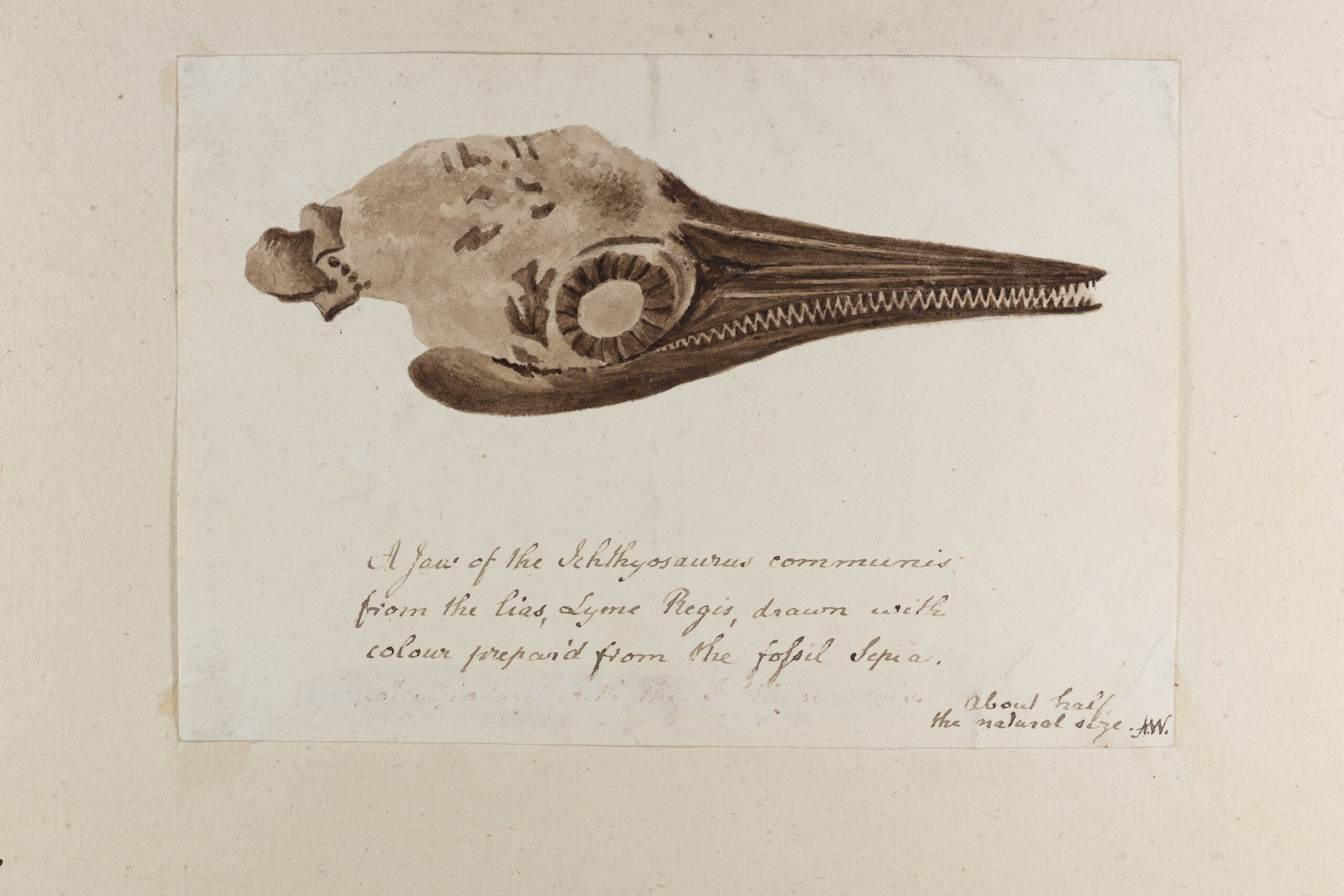
A fourth, previously unpublished, sepia drawing, not by Philpot, has been identified in the collections of the Yorkshire Museum, accompanied by a letter from the artist, Anne Wickham (1764–1857), presenting it to the museum’s Keeper, John Phillips (1800–1874). Anne and her sister Harriet (1765–1847) were the daughters of Lt Col. Henry Wickham (1731–1804), a retired soldier and banker, of Cottingley Hall, Bingley, Yorkshire, and his wife Elizabeth Lamplugh (1738–1815), and were descended from a long line of distinguished York clergy. From 1804 Elizabeth and her daughters lived in the city, and following Elizabeth’s death in 1815 Anne and Harriet were supported financially by their elder brother William (1761–1840), a diplomat and spymaster. Harriet’s interests were botanical (two albums of her plant watercolours are in the Yale Centre for British Art) while Anne’s seem to have been geological. In late 1833 Anne and Harriet were in Lyme Regis accompanied by their friends Major James Chadwick (1789–1859) and his wife Anne Isabella née Markham (1795–1870) who was from York and, like the Wickhams, had family connections to Minster clergy. At that time the Chadwicks were living in Budleigh Salterton in Devon and it may be that it was at their invitation that the Wickhams joined them in Lyme Regis.
In her letter to Phillips, dated Lyme Regis 23 December 1833 (Science Communications Volume I, Letter from Anne Wickham, December 1833. Yorkshire Philosophical Society Archive. Borthwick Institute for Archives, University of York GB 193. YPS/18/2007 Box 5a.), Anne describes visiting
‘The Misses Philpots who have a very fine collection of all the fossil remains that have been found on this coast’. Her visit must have taken place after Elizabeth Philpot’s 9 December 1833 letter to Mary Buckland, as Anne begins her letter by mentioning that ‘As the original drawing of the one I enclose has been sent to Dr Buckland, I venture to offer mine, if you think it worthy a place in your portfolio at the Museum’. Anne’s drawing in fossil sepia (Fig. 4) closely resembles Philpot’s drawing, including the caption ‘A Jaw of the Ichthyosaurus communis / from the lias, Lyme Regis, drawn with / colour prepar’d from the fossil Sepia. / contemporary with the Ichthyosaurus’ (but this last line is scratched out) and in the lower right corner, ‘About half the natural size. A.W.’ Drawn to the same scale and dimensions as those by Philpot, Wickham’s shows the same view of the skull, suggesting that it is a copy of a second Philpot drawing (the original had been sent to Oxford before Wickham visited Philpot) and not drawn from a study of the specimen itself. Wickham’s letter also informed Phillips that that she and Mrs Chadwick had bought ‘a few small specimens’ from Lyme fossil dealer Mary Anning (1799–1847) which they intended to present to the Yorkshire Museum on their return from Lyme. Their donation of fossil sepia, an ichthyosaur paddle and other fossils, along with that of the sepia drawing, was reported in the York Herald on 12 July 1834.
Identification of fossil sepia
Fossil cephalopods with preserved sepia ink sacs were first identified from the Lias of Lyme Regis in the mid 1820s by Mary Anning. She brought them to the attention of William Buckland (1784–1856) who, in 1826, sent a sample to sculptor Francis Chantrey (1781–1841) to test as a pigment. Where the idea came from that the fossil sepia could be reconstituted as a drawing medium is unclear, but it may have originated with Anning or Philpot. Chantrey used it in a drawing which he then showed to ‘a celebrated painter’, perhaps David Wilkie (1785–1841), who, unaware of its origin, ‘pronounced it … of excellent quality’ (Buckland 1836). There seems to be no contemporary identification of the subject of Chantrey’s drawing, but according to Lee (1875) it was a sketch of the fossil from which the sepia had been obtained. Although Chantrey’s drawing was made in 1826, it was not until a Geological Society meeting on 6 February 1829 that Buckland announced the identification of fossil sepia, in a paper describing Anning’s pterodactyle and coprolites. However, Buckland’s published paper gave no details of the sepia, but he did describe and illustrate specimens in his Bridgewater Treatise in 1836.
Of particular interest in Wickham’s letter is the formula she gives for the production of the fossil sepia ink: ‘The Sepia bag was ground down very fine & then prepar’d into a sort of cake, with Gum Arabic & brown sugar – the proportions, an Oz. [ounce] of Gum Arabic & one fourth of Sugar, & when used it works as smooth as modern sepia’. Wickham must surely have obtained this information
directly from Philpot so this may be Philpot’s (or Anning’s?) own formula. The Gum Arabic acts as a binder for the pigment, and the addition of sugar may improve the flexibility of the brittle Gum Arabic and prevent the cake cracking. For use, the cake would be wetted and rubbed.
A fashion for fossil sepia?
Drawing with fossil sepia seems to have been popular in and around Lyme Regis in the 1830s, with supplies provided by Anning. Lyme historian George Roberts (c.1804–1860) noted that ‘Miss Anning works up for friends the sepia of these bags, and beautiful drawings have been made from it’ (Roberts 1839), implying that Anning was providing processed fossil sepia, perhaps as cakes ready for use, as well as the fossils themselves. John Murray (c.1786–1851) who visited Anning in about 1836 acquired sufficient fossil sepia ink to print multiple copies of several lithographed plates for his publications, including one of Pentacrinites from the Lias of Lyme Regis as the frontispiece for his 1838 book A Portrait of Geology (Sharpe 2023). Murray (1847) also later recalled that Anning had shown him a fossil sepia drawing of an ichthyosaur which Chantrey had made for and given her.
A small sketch of what appears to be an organ grinder, captioned ‘Drawing in fossil Sepia Lyme ’and signed ‘C. Jenyns’ is attached to the tablet of a specimen of Sepiateuthis from Lyme Regis in the collections of the Sedgwick Museum, University of Cambridge (CAMSM X.40588, Fig. 5). Jenyns may be Charles Jenyns (1798–1887), a barrister and amateur artist who was probably also responsible for a mountain landscape ‘Coloured with fossil Sepia procured from the Lias at Lyme in Dorsetshire ’in the archive of the Linnean Society (MS651). It is likely that Jenyns was the donor of the sepia specimen and that he acquired it in Lyme Regis, but as no details of the date of the donation or of his visit to Lyme are recorded it cannot be linked definitively to Anning.
Sedgwick sepia Sturge skull
Coincidentally, the small ichthyosaur skull which features in the 1833 fossil sepia drawings by Philpot and Wickham is also in the Sedgwick Museum. The specimen (CAMSM J.47057, Fig. 6 ), which is in the round, has been prepared to expose the back of the skull and the cervical vertebrae and in this it corresponds to a drawing in letter, probably from early 1834, from Philpot to William Buckland. This drawing (OUMNH WB/A/1/361 Fig. 7), showing the prepared specimen at natural size, was not made using fossil sepia, although it was accompanied by a fossil sepia drawing of a fossil ink sac in Philpot’s collection. The Somerset fossil collector Thomas Hawkins (1810–1889) had visited Lyme, Philpot told Buckland, ‘and obligingly took the trouble of clearing the limestone from the specimen and has developed the remainder of the bones’. Buckland had expressed an interest in figuring the skull in his Bridgewater Treatise, but Hawkins’ preparation work rendered it, in Philpot’s opinion,
too fragile to send to Oxford. According to Philpot’s letter of 9 December 1833, Mary Anning considered ‘this Jaw the most perfect perfect [sic] specimen she has ever met with’. Does this frustrating ambiguity imply that the fossil had been found by Anning? Or had the Philpots found it and was it simply the best Anning had ever seen?
The Philpot fossil collection was given to OUMNH in 1880 but this skull was presented to the Sedgwick in 1919 by Mrs J. Sturge. Julia Sturge née Sherriff (1846–1926), the daughter of Alexander Clunes Sherriff (1816–1878) Liberal MP for Worcester 1865–78, was the widow and second wife of physician William Allen Sturge (1850–1919) whom she married in 1886. Sturge was born in Bristol, son of William Sturge (1820–1905) and Charlotte Allen (1817–1891), and named after his father and in memory of William Allen (1770–1843) a cousin of his mother, and a founding member of the Geological Society (Sturge 1928). The Sturges were a long-established Quaker family of land surveyors, amongst whom was John Player (1725–1808) (Torrens & Gill 2018). W.A. Sturge, however, followed a medical career, training in Bristol, London and Paris. From 1877 he and his first wife, Emily Bovell (1841–1885), one of the ‘Edinburgh Seven’ women medical graduates, had a practice on Wimpole Street in London but in 1881 as Emily’s health declined, they moved to Nice on the French Riviera. Sturge remarried after Emily’s death and remained in Nice until his retirement in 1907.
Sturge’s interests post-retirement were mainly archaeological, and he built up an important collection of flint implements which he kept at his home, Icklington Hall, near Mildenhall in Suffolk and which went to the British Museum after his death. A collection of European Tertiary fossils from his time living and travelling on the continent was left to the Natural History Museum. In 1919 his widow’s move to Winscombe, Somerset, occasioned a further disposal of possessions, which may explain her separate donation of the ichthyosaur skull to the Sedgwick Museum.
How the fossil escaped from the Philpot collection and came into Sturge’s possession we have yet to ascertain, nor have we been able to establish any connection between the Sturges and the Philpot family in Lyme Regis, although Jacob Player Sturge (1796–1857), W.A Sturge’s grandfather, was a contemporary of Anning and Philpot. William Sturge was a member of the Bristol Institution but there are no records of any geological donations to its museum by him, nor any indications of a particular interest in fossils by either of them. William did publish a paper on agricultural geology in the Transactions of the Institute of Surveyors in 1874, but its content reflects the geological knowledge which a surveyor would possess in order to assess and value land.
Elizabeth Philpot was the last of the three sisters who lived in Lyme, and on her death in 1857, their house and fossil collection passed to their nephew John Philpot (c.1809–1878) whose widow gave the collection to Oxford. Elizabeth seems to have been a careful custodian of her collection, reluctant to lend fragile fossils and reminding borrowers, especially Buckland, to return specimens, so it seems unlikely that she would have disposed of such a fine ichthyosaur skull. It may have left the Philpot collection sometime between 1857 and the donation to Oxford in 1880, passing through the hands of one or more intermediaries before ending up, in the first decade of the 20th century, in the possession of William Allen Sturge and his wife. Until further evidence comes to light the fossil’s migration from Morley Cottage to Icklington Hall must remain a mystery.
References
Buckland, W. 1836. Geology and Mineralogy considered with Reference to Natural Theology. London: William Pickering.
Lee, H. 1875. The Octopus. London: Chapman & Hall.
Murray, J. 1847. The Late Miss Mary Anning. Mining Journal, v.17, 591.
Roberts, G. 1839. An Etymological and Explanatory Dictionary of … Geology. London: Longman, Orme, Brown, Green, & Longmans.
Sharpe, T. 2023. John Murray (c.1786–1851) and his use of fossil sepia. GeoHistories, no.76, 27–28.
Sturge, E. 1928. Reminisences of my Life. Privately published.
Torrens, H.S. & Gill, M. 2018. John Player’s ‘Geological Observations’ of 1764–1766, and his contributions to the Society of Arts Journal Museum Rusticum et Commerciale. Earth Sciences History, 37(2), 247–265.
Acknowledgements: We are grateful to Simon Knell who first located the Wickham drawing in 1993; and for the assistance of Deborah Hutchinson, Bristol Museum; Richard Bull; and Mike Taylor; and to Danielle Czerkaszyn, Oxford University Museum of Natural History; Lydia Dean, Borthwick Institute for Archives, University of York; Caroline Lam, Geological Society; and Matt Riley, Sedgwick Museum who also provided details of material in their care and allowed their reproduction here.
Tom Sharpe tom.sharpe1@me.com
Sarah King sarah.king@ymt.org.uk
Figures
Fig. 1 Drawing in fossil sepia by Elizabeth Philpot enclosed with her letter of 9 December 1833 to Mary Morland (OUMNH WB/A/3/022).
Fig. 2 Drawing in fossil sepia by Elizabeth Philpot (OUMNH WB/A/3/022).
Fig. 3 Drawing in fossil sepia presented by H.T. De la Beche to the Geological Society (LDGSL/642 Reproduced courtesy of the Geological Society of London).
Fig. 4 Drawing in fossil sepia by Anne Wickham, Yorkshire Museum.
Fig. 5a Sepiateuthis, Lias, Lyme Regis (CAMSM X 50488).
Fig. 5b ‘Drawing in fossil Sepia Lyme’ by C. Jenyns.
Fig. 6 Ichthyosaur skull (CAMSM J.47057).
Fig. 7 Drawing of ichthyosaur skull by Elizabeth Philpot, 1834 (OUMNH WB/A/1/361)